

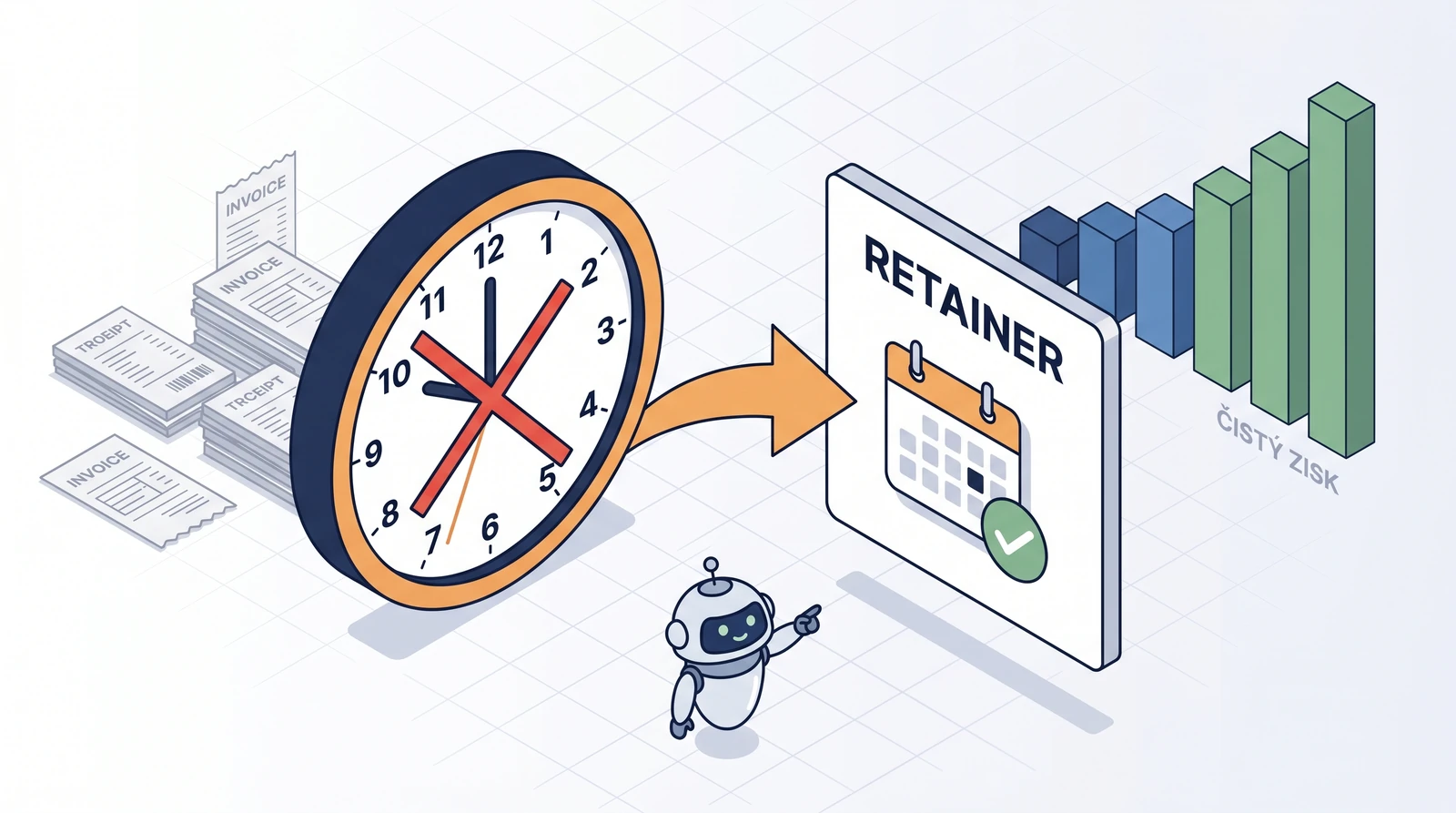
Problem: I experienced a paradox that took me six months to put a name to: the better I work, the less I earn. A task that used to take eight hours now takes me two with an AI assistant. The client is happy — they get it faster and cheaper. I get paid for two hours instead of eight. My profit from a single job dropped by 75%.
This isn’t a complaint. It’s a signal that the pricing model I’ve been using for four years has stopped working. I’ve written down how I recalculated it, what I’m actually charging now, how I communicate it to clients, and what I think every PPC freelancer or small agency should consider before it’s too late.
Table of Contents
1. The hourly rate paradox: my reality last year
Standard model: 1,500 CZK/h × actual hours worked. I track my time in Toggl, the client gets a monthly report, and I invoice.
Last March, an average month for a medium-sized e-commerce client looked like this:
- Preparation of the monthly report and comments: ~3 h
- Search terms audit and negatives: ~2 h
- PMax asset group performance analysis: ~2 h
- Bid and budget adjustments: ~1.5 h
- Meta campaign support: ~2 h
- Ad hoc communication: ~1.5 h
- Total: ~12 h → 18,000 CZK per month
After gradually implementing the MCP stack (I wrote about it in the article about the MCP stack), the same scope looks like this:
- Report including cross-platform data: ~45 min
- Search terms via MCP + auto-suggested negatives: ~30 min
- PMax performance pull + commentary: ~40 min
- Bid/budget changes via draft → approve workflow: ~30 min
- Meta support: ~45 min
- Ad hoc: ~60 min
- Total: ~4.5 h → 6,750 CZK per month
The client got the same output faster and more accurately. I got 11,250 CZK less. For the same expertise.
The defining moment came when the client wrote to me: “Send a more detailed report; for that kind of money, you could be doing more.” — at that point, my hourly rate forced him to think that “if he’s paying less, he should be getting less work”. In reality, more data, more suggestions, and faster reactions were being delivered. They were just expressed in fewer billable hours.
Hourly billing communicates price as a function of time, not value. And the moment AI breaks the link between time and value, hourly rates stop reflecting reality.
2. Pricing models I considered
Before I looked for a replacement, I sat down and mapped out the options. Not academically—with numbers that actually make sense for my clients.
1. Hourly rate (status quo)
Pros: Clear, the client understands it. Transparent. Fair for one-off tasks (audit, migration).
Cons: Penalizes productivity. Earnings cap = hour cap × rate. You can’t scale capacity.
Where it makes sense: One-off projects, audits, consultations, setting up a new campaign without follow-up.
2. Retainer (flat monthly fee)
Pros: Predictability for both sides. Price reflects value, not time. Scales with efficiency—saved hours = my margin.
Cons: The client doesn’t understand exactly what’s included in the retainer. Risk of scope creep (“it’s in the retainer, right?”). If you price it wrong, you’ll be losing money in no time.
Where it makes sense: Long-term campaign management, retainer for performance growth.
3. Performance-based (% of revenue, CPA/ROAS target)
Pros: Interests aligned with the client. The earnings ceiling is much higher when you grow.
Cons: Volatility (seasonality, macro cycles, issues outside of PPC). Attribution headaches—who actually drove the revenue? Complicated contract.
Where it makes sense: Large accounts with clear attribution, clients with a long-term vision, ideally with in-house analytics for verification.
4. Hybrid (retainer + performance bonus)
Pros: Fixed costs covered by the retainer + upside via the bonus. A compromise that reduces both volatility and the upper limit.
Cons: More complex contract. You need to define what counts as “above the baseline.”
Where it makes sense: Mid-sized clients with a growing portfolio where I trust the data.
5. Value-based (price per specific deliverable)
Pros: The client knows exactly what they’re paying for (“audit Google Ads for 35,000 CZK”). It doesn’t matter if it takes 4 or 12 hours.
Cons: Harder to estimate for more complex work. You need templates for typical projects.
Where it makes sense: Packages (Audit, PMax launch, GA4/GTM migration), one-time consultations.
3. What I'm actually doing right now (April 2026)
After six months of experimenting, I’ve settled on a combination of three models based on the client type:
Long-term campaign management → retainer + a clearly defined scope (list of channels, reporting frequency, SLA response times for critical events).
I’ve set the retainer at a level that gives me about 70% of what I would have earned on an hourly basis for pre-AI estimated hours. The client pays less, I work faster, and we’re both happy. At the same time, I have the breathing room to add things to the scope that I didn’t have time for before (proactive feed audits, landing page feedback, copy A/B tests) — I’m increasing the perceived value without raising the price.
One-off projects (audit, setup, migration) → fixed price based on tiers. For a Google Ads audit, I have three levels (15,000 / 35,000 / 75,000 CZK) depending on the depth. The client knows the cost upfront, and I have templates in my google-ads-audit skill that maintain quality across all clients.
Consulting, developing a new channel, ad hoc expert work → hourly rate, but higher (2,200 CZK/h instead of the original 1,500). AI saves less time here because it’s cognitively demanding expert work — and the client is happy to pay for it because they don’t see an alternative.
I currently have a performance bonus with two clients where the attribution is clean and I’ve been deeply immersed in their data for a long time. It’s 5% of the measurable incremental revenue above the baseline from the previous three months. It’s administratively demanding, but for one large client, it added ~85,000 CZK to my annual income last year.
4. How I communicated this to my clients
This was the part everyone who asked about the switch was worried about. It wasn’t nearly as painful as I’d expected.
For my long-term clients, I didn’t frame it as “I’m raising my rates” or “I’m changing my model.” Instead, I pitched it as “I’m expanding the scope for the same total price.” Instead of hourly billing, they moved to a retainer close to their average monthly billables. I defined the scope with a clear table (what’s included in the retainer vs. what’s extra). Not a single client left.
For new clients, I started offering a retainer as the default. Hourly rates vanished from my proposals. This boosted my close rate—there’s less friction in the decision-making process when a client sees a clear figure like “I’m paying 25,000 CZK a month” instead of “I’ll be paying 1,500 × X hours.”
For project-based work, I switched to fixed pricing with clearly defined deliverables. For audits, it works like a standard product: “here’s what you get, here’s the price, and the turnaround is 10 business days.” I’m closing about 80% of sales calls without any negotiation.
5. The psychological part (and why it was the toughest)
The transition wasn’t a mathematical problem. It was a psychological one.
Fear #1: “If I quote a flat fee of 25,000 CZK, the client will realize I’m actually only working 4 hours a week and won’t want to pay.”
In reality: the client doesn’t measure my hours. They measure the result. If campaign performance holds or grows, the flat fee is fair to them regardless of my actual time investment. (They also don’t care how much fuel the taxi from the airport used — they pay for the delivery, not the inputs.)
Fear #2: “Flat fee = I’ll be doing the same amount of work for less.”
In reality: I set the flat fee so that it cuts my gross revenue in exchange for increasing net profit (fewer hours, lower overhead, less admin). And most importantly — it frees up capacity for other clients or deeper strategic work for existing ones.
Fear #3: “I’ll lose control over how much I invoice. I’ll be struggling month to month.”
In reality: the opposite. A flat fee is a cashflow predictor. I know 3 months in advance what’s coming in. My financial planning has calmed down significantly.
It took a while to talk myself out of all three fears — for my own sake, not the clients’.
6. A framework for how to start the transition
If you want to take the same step, here’s what I wish I’d had in one single list:
- Map out the actual time spent per client over the last 3 months (Toggl/Harvest/manually). Average monthly hours × your rate = your current “utility” from the client.
- Subtract the time that AI/automation actually saves. Be honest — that 70% reduction won’t happen overnight. Realistically, count on 30–40% savings in the first year.
- Set the flat fee close to your original billing, not close to your current costs. The client is buying value, not your overhead.
- Define the scope strictly. “What’s included in the flat fee” as a bullet list, “What’s excluded” as another. Without this step, your flat fee will drift over 6–12 months toward
tržbě dodávka 80 % služeb za 60 % ceny— scope creep. - Test it on 1–2 clients, not your entire portfolio at once. Observe how it works for 3 months and adjust.
- Prepare project-based packages (audit, PMax launch, GA4 migration). Fixed price + clear output = the best selling point for new clients.
- Keep the hourly rate for things that make sense. Expert consultations, unexpected projects, or clients who insist on hours. You lose nothing by doing so.
7. What I'm aiming for in the long run
Moving to retainers and fixed-price projects isn’t an end in itself. It’s a shift from being a “freelancer looking for gigs” to a “provider with a predictable business.” This shift allows me, among other things, to:
- Invest time into tools (I wrote about the MCP stack), without billing it to anyone specific
- Write articles like the one you’re reading right now—without feeling guilty about losing billable hours
- Be pickier with clients, because portfolio quality > billing quantity
- Have a capital reserve because I know my cashflow
If AI really turns the industry upside down—and I believe it will—a freelancer sticking to hourly rates will be working for half as much in two years. A freelancer with retainers and packages will grow because the price of their services isn’t tied to the falling cost of code.
Conclusion
Hourly rates aren’t bad. They’re simple, and after four years, I’ve realized that simplicity was their main advantage—I didn’t have to explain anything, I didn’t have to justify anything, I just tracked my time and sent out invoices.
But simplicity stopped being enough the moment my efficiency improved faster than the market could adjust price expectations. AI opened that gap and will keep widening it. Anyone who stays stuck there with an hourly rate will be paying for someone else’s growth out of their own pocket.
If you’re dealing with this now or will be soon, I’d love to chat about it—specifically how to switch to retainers with existing clients, how to set the scope, and what to avoid. I’ve been through it and have a few stumbles along the way. I’m happy to share what I’ve learned.
Are you switching to flat fees and need a second pair of eyes?
FAQ (for the curious)
- How much did switching to flat rates bring me in the first six months? About 12% less revenue and 40% more net profit with the same number of clients. Plus, extra bandwidth that I now fill with higher-quality work for those clients and by acquiring new ones.
- Could you go straight to a flat rate with a new client, without hourly billing? You can. It’s my default. The only thing that complicates it is the first month—you don’t know the real scope. I handle it by making the first month “exploratory” for a flat 15,000 CZK, with the understanding that we’ll set the flat rate in the second month based on the actual workload.
- What if a client tells me “I want to see the hours”? I refuse. I measure outputs and results, not time. For a client who insists on hours, I offer an hourly project separate from the flat rate, or I walk away. In four months, it happened once. The client stayed, and the questions stopped.
- I have a small business, is a flat rate realistic? Yes. A flat rate of 5,000–8,000 CZK for a smaller account is fair. Below that, it’s not worth it for the client (it doesn’t make sense to have a freelancer) or for me (overhead kills the margin).