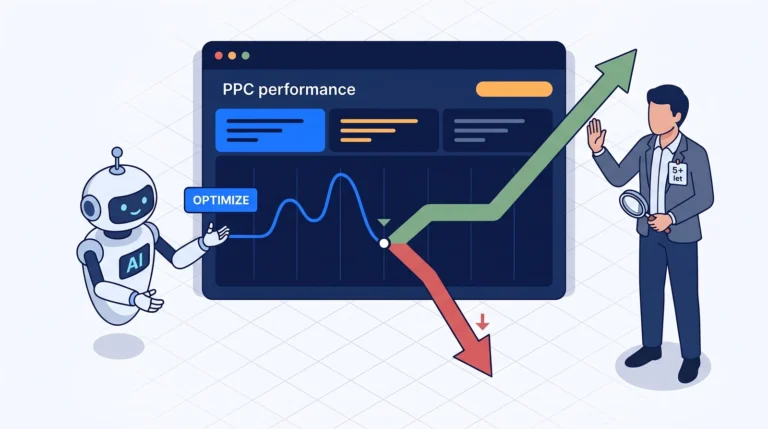


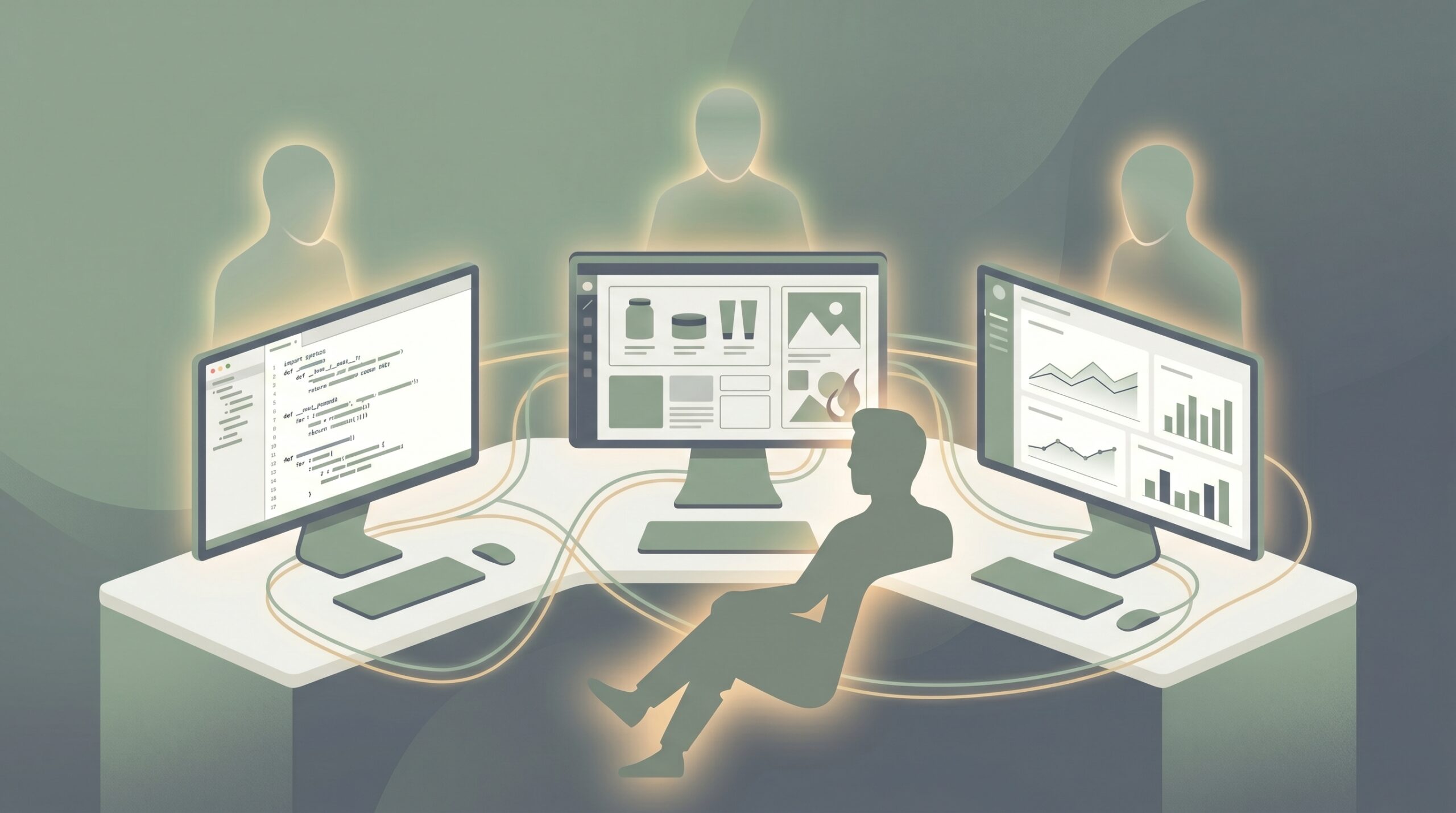
My AI marketing team in action: programmer, designer, and junior PPC specialist from the same console
Problem: A freelance marketer is one person who has to be a copywriter, coder, designer, analyst, project manager, and salesperson — ideally all at once and by Friday. If you’re good, you handle three roles. If you’re excellent, you manage five, but quality drops. You outsource the rest for money that eats into your margin, or you simply run out of time and the client checks in: “where are those creatives?”
This article is about how this equation changed in 2026. Not because I hired people — but because I now have an AI team at my back. Specifically, a developer who writes custom integrations and my own internal app for me. A designer who churns out ad creatives for 23 CZK/set. And a junior PPC specialist who keeps up with audits, negative keyword suggestions, and periodic reports. None of them exist as actual people — but the output does. And it’s deployable, repeatable, and measurable.
I’m writing this from the perspective of a freelancer with about 20 clients across e-commerce, local SMBs, and B2B SaaS. I sit at one console and this crew is right there, waiting for an assignment. Let’s break down who does what, where the boundaries are, and when it makes sense to build a team like this.
What it means to have an AI team (and why it’s not sci-fi)
I don’t treat AI like a tool in the sense of “open Photoshop, click, close.” I treat it like a colleague — I assign a task, it returns an output, I say “not like this, like that,” and we iterate until it’s exactly what I want. The difference compared to what “AI in marketing” looked like two years ago is that the agent now holds context (across files, MCP servers, clients) and can take actions (read Google Ads, generate images, write to WordPress), rather than just writing text in a chat window.
This crew didn’t just show up yesterday. MCP (Model Context Protocol) has been around for a few years, Claude Agent SDK has been available in Python since last year, and NanoBanana has had 4K generation since the summer of 2025. What changed this year is that you can piece it all together into something that acts like a team — each “colleague” has their own tool, their own prompt skeleton, and their own responsibility. I’m the PM, code reviewer, and strategist all in one.
This metaphor isn’t a marketing buzzword — it’s a framework. When I say to myself, “I need a junior PPC specialist to do a Google Ads audit for client X,” I actually switch the agent template to an audit template, give it the account ID, and it pulls data via MCP, calculates benchmarks, and returns an XLSX. I review it, fix it, and send it to the client. The workflow is structurally the same as if I had a real junior sitting right next to me. It’s just faster, tireless, but also dumber — without a senior (me), it would be lost.
A developer on the team: apps, integrations, and custom tooling
This project is the most visible result of my work over the last six months. I have my own internal app — app.marketak-ze-severu.cz, live in production since May 13, 2026. I built it with an AI assistant in just a few weeks instead of the six months it would have taken if I’d hired a contractor.
What the app can do today:
- Client mgmt — 47 clients in the DB with brand assets (logo, colors, tagline), notes, AI web scraping for quick onboarding
- Projects + tasks — CRUD per client
- Time tracking — timer, edit, autocomplete, two tabs (Current + Report) with Chart.js charts, XLSX export with effective hourly rate per client, PDF print
- AI Chat via Claude CLI subscription (= €0 for the API if you have Pro/Max)
- Asset library — R2 storage, gallery, approval status flow
- Prompt library — CRUD + tags + copy-to-clipboard + usage counter
- Audit log viewer — who, what, when
- Auth with 2FA + OAuth + user management + per-user hourly rates
- Agent runs — 5 templates on top of MCP (audit / creatives / report / negatives / multi-agent audit-review), 3 models (Sonnet / Haiku / Opus) selectable per session, background continuation
The stack in one sentence: Python 3.14 + FastAPI + HTMX 2 + Tailwind 4 + PostgreSQL 17 + pgvector + Dramatiq queue, on Hetzner CPX31 in Falkenstein, deployed via Docker Compose behind Caddy, R2 for storage.
What I actually wrote myself: the specs. Architectural sketch. Code review. Bug reports. Design decisions (“no, the report tab goes next to it, not under it”). What AI wrote: practically all the Python code, Jinja templates, Alembic migrations, Tailwind utility classes, deploy scripts, healthcheck cron, restic backups. 24 PRs during development, plus 7 PRs for the Agent SDK migration — all merged only after my review.
This app is an extreme example. For smaller tasks — like “I need to connect a Pipedrive lead to Google Ads as an offline conversion without Zapier” — 45 minutes and Google Apps Script is all it takes. I described it in detail in the article about Pipedrive → Google Ads without Zapier. The key: I don’t write code like a programmer; I specify and review. Claude plays the role of the “junior dev.” I handle the tech leadership.
This has profound implications for a marketer who has never coded. Suddenly, a lack of syntax knowledge isn’t standing in your way — the only thing in your way is whether you can describe what you want, how it should work, and whether you can tell that it’s not working when it’s handed back to you. Programming has shifted from “I can write code” to “I can lead code.” And that’s a completely different ceiling.
A graphic designer on the team: creatives, visuals, and brand assets
Second role: graphic designer. For product ads on Meta and Google Ads, I use NanoBanana (Gemini 3.1 Flash Image) as part of a seven-step workflow:
- Product WebFetch — I pull USPs, copy, motto, and image URLs from the client’s e-shop
- Download 2–4 product photos — I handle JS-render, cookie filters, and hash suffixes per source
- Define the funnel stage → I pick a CTA from my library (acquisition “Learn more” / retargeting “Continue” / cart “Complete purchase”)
- Select 3–6 patterns from my library of 16 styles (a mix of awareness + consideration + conversion)
- Adapt the EN prompt with Czech copy (NanoBanana handles Czech diacritics without any issues)
- Generate in parallel 4:5 (Feed) + 9:16 (Stories / Reels)
- Eval and iterate based on the AIDA framework
What this means in practice:
| Task | Traditional way | My AI designer |
|---|---|---|
| Set of 12 ads (6 patterns × 2 formats) | Designer 4–8 hours, 5,000–15,000 CZK | 30 minutes + ~17–23 CZK compute |
| Iterations (copy, color, or layout changes) | Another 1–2 hours + cost | ~6 CZK, regenerated in a minute |
| Brand consistency | Brief, moodboard, proofing | 2-input pipeline (product + logo), brand-pack from the _meta/brand-assets/ folder |
Recent specific results: for Kovallo (kitchen spoons), I built three patterns; for Trinfit / Fitham (fitness equipment), six patterns in two formats. Both started as a workflow test, but today it’s the standard procedure for new ads across all clients. I have my library divided into 16 styles with a breakdown in English prompts, plus the AIDA framework and 30 ad types per Common Thread Collective.
What an AI designer can’t do (or does poorly):
- Brand wordmark — the model sometimes goes off the rails or hallucinates its own font. Workaround: pass the logo as a 2nd input, always from the client’s website, not a local copy — that might be outdated.
- Multi-SKU listing — if you want four products in a specific order, the model might swap them around. Manual review.
- Competitor comparisons — “better than [competitor]” is legally risky in the Czech Republic; I don’t include competitor brands in ad copy.
- Anything that needs a stylistic shift — if you want a major creative twist that doesn’t exist anywhere in the advertising world, AI will just give you a mix of what it’s already seen. You have to provide that shift yourself (often with a sketch).
Bottom line: an AI designer covers 80% of routine creative tasks with quality comparable to a mid-level designer at a fraction of the cost. The final 20% (rebranding, identity, illustrations with a signature style) I either handle with a real designer or don’t do at all.
Junior PPC specialist in your team: routine tasks, audits, and recommendations
The third role — the junior PPC specialist. This is the most hardcore one, yet paradoxically, it makes the smallest impression because the work they do is routine. No viral output. Just the fact that it works.
I’ve got five agent templates ready in Marketak App:
1. Google Ads account audit
In three depths (quick-scan / standard / deep), with an XLSX output covering the economics (LAST_90 vs PREV_90 + YoY), seven standard sections, and threshold benchmarks for e-commerce vs. B2B vs. local. A junior PPC specialist would spend 1–2 days on this. The Agent gets it done in 5–15 minutes (per quick / deep tier), and I review it in 30 minutes.
2. Negative keyword suggestions
The agent pulls the search terms report from the LAST_30, fragments it into n-grams, and suggests negative candidates (at the ad group / campaign / account level). It filters for brand safety (for example, for a retailer selling specific product brands, it won’t recommend blocking those brands — a typical rookie mistake). A junior PPC specialist would spend an hour mapping this out in Excel, but the agent returns the list in two minutes.
3. Creatives (RSA headlines / descriptions)
It extracts USPs from the product page URL (HTML, ld+json, itemprop) and returns a draft of 15 headlines / 4 descriptions. Strictly no making stuff up — if it’s not on the client’s site, it doesn’t go into the ad. No “SALE ENDS FRIDAY” if that sale doesn’t exist. This is one of the core rules I build my entire workflow on — misleading advertising is a legal risk I avoid by verifying the validity of every promotion directly on the client’s website.
4. Periodic report
LAST_30 vs PREV_30 trends, automated flags (CTR drop > 20% / CPC spike > 30% / conversion fell below the threshold), draft text for the client. A junior PPC specialist would spend two hours reporting; the agent does it in fifteen minutes.
5. Multi-agent audit-review
This is where Claude plays against itself: agent #1 proposes the audit and recommendations, while agent #2 plays the “skeptical client” and pokes holes in the logic. It then returns a list of open issues to resolve. This really catches errors that I, as a solo reviewer, would likely miss after my fifth audit of the week.
What makes multiple models possible:
- Haiku for batch tasks where speed and price are key (negative KW suggestions)
- Sonnet for standard audits and reports (balancing quality and price)
- Opus for multi-agent reviews and deep analysis (maximum quality)
You select the model per session in the Marketak App UI. This is where it differs from how most people use ChatGPT — not one model for everything, but the model as another workflow parameter that you choose based on the task.
What an AI team Junior PPCer can’t handle:
- Strategy — why a client uses Google Ads instead of Sklik, what the core USP is, where the next investment lies. This is handled by the senior (me).
- Client communication — the agent won’t send an email to the client, won’t hop on a call, and won’t explain why we didn’t do something.
- Final write to the production account — the agent can suggest, but never writes on its own. There’s always a confirmation step by a human. I handle restrictive changes (pausing campaigns, geo negs, budget caps) with a specific explicit question, not just a row in a summary table.
An AI team junior is perfect for repeatable, well-defined tasks with a clear output. If the task is vague (“optimize campaigns”), it’ll give you a vague output. If the task is specific (“find me search terms with CTR > 10 %, but 0 conversions over the last 30 days”), it’s faster and more thorough than a real-life junior.
How it’s all orchestrated (a look under the hood)
For this “team” to function as a whole, you need a backbone—a protocol that connects the agent with real systems.
Model Context Protocol (MCP) is that backbone. In short: a standardized way for Claude (or another LLM) to call external API and file systems via tools. In my setup, MCP servers provide access to:
- Advertising platforms: Google Ads (default MCC + two sub-accounts), Sklik, Meta Ads, Microsoft Ads
- Analytics: GA4 (per-client wrapper), MarketingMiner, Search Console, BigQuery
- Generative AI: NanoBanana (Gemini Flash Image), Kling AI (video), Veo (Gemini video)
- WordPress: Elementor MCP for marketak-ze-severu.cz and other client websites
- Heureka, DataForSEO, Apify — for feed and SERP analytics
A total of 25+ registered servers, each with its own wrapper script and DPAPI-encrypted credentials in the user profile. I broke it down in more detail in the article about MCP for PPC specialists — you’ll find an architectural overview of the entire stack there.
In the Marketak App, the Claude Agent SDK 0.1.81 Python sits on top of it — a library that turns sessions, models, and tool calls into something that behaves like an autonomous agent. When I run an audit template, the agent gets the initial prompt, MCP tools, and the model, then runs in the background — I can hop on a call, come back, and the result is in R2 storage. I can continue the session, switch models, or use the AskUserQuestion modal for decision points.
Security is one of the main criteria. No secrets in mcp.json or git. All tokens go through DPAPI-encrypted files in the user profile. MCP servers never write to advertising systems without a confirmation step (via the Marketak App UI or terminal). If the agent suggests a change, I see a draft and confirm it manually.
This architecture isn’t low-code drag-and-drop. It’s a deliberately technical setup that rewards the time you pour into it. Once it’s built, it does the grunt work for you. If you only have it halfway done, it’ll create more problems than it solves.
What this actually changes in your day-to-day work
The breakdown:
| Task | The traditional way | With an AI team |
|---|---|---|
| Set of 12 ads | 4–8 hours external designer, 5,000–15,000 CZK | 30 min + ~23 CZK compute |
| Google Ads account audit (standard) | 1–2 days of my work | 15 min agent + 30 min review |
| Custom integration (Pipedrive → Google Ads) | A week of developer time, 30,000+ CZK | 45 minutes with AI |
| Client onboarding (scrape, brand pack, audit) | A day+ | 1 hour in Marketak App |
| Periodic report | 2 hours | 15 min agent + 15 min review |
| Negative KW suggestions (30 days) | 1 hour in Excel | 2 min agent + 5 min review |
Important disclaimer: The AI team speeds me up, but it doesn’t increase my capacity 10x. The bottleneck remains the review and client relationship. If I have 20 clients, I can handle more than if I were doing everything myself, but I won’t be handling 200. The ceiling is my brain’s capacity to review, not the agents’ capacity to produce.
What really changes, though, is the task breakdown. When a client comes to you on Monday saying “I need to prepare a campaign launch for a new product by Friday,” a traditional marketer has to go step-by-step: research, creatives, campaign structure, conversion tracking, copy, approval. That’s a week or more. With an AI team, I can run things in parallel: one agent scrapes USPs from the web, NanoBanana generates patterns, a second agent suggests the campaign structure based on benchmarks, and a third prepares the conversion tracking checklist. I review it piece by piece over the course of two days.
The second change: the baseline quality. A junior PPC specialist in an AI team will never miss a suggestion that a senior would recognize as standard (like “this ad group is missing pause keywords in a campaign with a 10,000+ CZK / month budget”). There’s no human fatigue factor. This has pushed the baseline quality of client outputs for routine tasks significantly higher.
Boundaries (what the AI team can’t do and what you shouldn’t trust it with)
To keep this from sounding like a sales pitch, let’s get straight to what the AI team can’t do:
1. Client strategy and positioning. When a client tells me “our ROAS is dropping, what should we do?”, an agent can spit out 20 hypotheses, but the decision to “invest in Heureka or Meta, or rebuild the product feed” is a strategic choice with economic consequences. That’s done by a human who knows the client’s business, seasonality, competition, and brand concept.
2. Client relationships. An AI team won’t send a reassuring message on a Saturday night, hop on a call, or explain in plain English why we were 15% below target last month. This isn’t a negligible part of a marketer’s job. For the client, the value often lies more in knowing that someone is handling it than in the numbers themselves.
3. Creative direction. When you’re entering a new vertical with a client, rebranding, or launching an experimental campaign—AI will give you back the “average of what it’s seen.” If you want to surprise people, make a shift, or add your own signature style, that’s on the human. AI gets you to 80%, the last 20% is yours.
4. Final ad review or audit before publishing. Always a human. Deceptive advertising (like “BUY 3 GET 1 FREE” in an RSA when the promo ended last week—a real case from one of my e-com clients) is a legal risk. Data in an ad must be verified from the client’s website, not hallucinated by a model. This is one of the main reasons I never let an agent loose on a production account blindly—an agent can suggest, but a human always does the actual writing to the account.
5. Bypassing safety in production. I never call MCP write tools without a confirm. The AI team plays the role of a junior, not a senior. The senior—that’s me. If anyone is selling an “autonomous agent that manages your account on its own,” they’re either naive (and will get burned soon) or they’re lying.
When to start building your own AI team (and when not to)
It makes sense for:
- A freelancer with five or more clients across various verticals — repetitive tasks (audit, creatives, report) scale well, and the ROI on the setup is roughly 3–6 months.
- White-label part-time — if you’re sub-contracting for agencies where output volume is tied to delivery time, an AI team gives you capacity without hiring more people.
- Small / mid agency with repeatable outputs — you’ll boost output per FTE without increasing headcount.
It doesn’t make sense for:
- An in-house specialist on a single account — the setup investment is overkill. An agent will help you with specific tasks (Cursor IDE, ChatGPT Plus), but you don’t need a whole “team.”
- A client with a single campaign — hiring a good freelancer is a better deal (the math works out better).
- A newbie without a baseline — you won’t recognize a good audit, you won’t spot when a model is hallucinating, and you might push something to production that you’ll regret. Learn it manually first.
Barrier to entry (realistic estimate):
- Time: 40–80 hours for the first functional setup (MCP servers, wrappers, credentials, one functional workflow)
- Learning: Python basics + Bash + concept of MCP servers + Claude Agent SDK, if you want to go deep
- Price: Claude Pro / Max subscription (tens of USD per month) + ad hoc API credit for batch generation + ~€13 per month for Hetzner if you want to deploy your own app
You don’t need a full-time junior dev — you need two weekends and a willingness to learn. Almost my entire library of wrappers, skills, and templates is transferable for anyone who wants to launch a similar setup on their own.
Conclusion and where things will be in two years
In 2026, a marketer with a functional AI team is a competitive advantage. You can handle more clients, deliver higher-quality work, and meet tighter deadlines — all without hiring and training people.
By 2028, it will be the standard. A marketer without an AI team will be like an accountant doing a budget in a notebook instead of Excel — technically possible, but practically uncompetitive. Those who adapt early will have a head start in productivity, quality, and most importantly, in the mental model of how to integrate AI into their workflow.
If you’re interested in diving deeper, check out my article on MCP for PPC specialists — that’s where the architectural details are. Or the Pipedrive case study, where you’ll find a specific example of how an AI team builds a custom integration in 45 minutes. There’s more technical substance there.
Tech FAQ
Which model do you use for what?
Sonnet for standard audits and reports. Haiku for batch tasks — negative keywords, scraping client websites. Opus for multi-agent reviews, deep audits, and complex code refactoring.
How much does it cost per month?
A Claude Pro / Max subscription covers most AI Chat and agent runs via CLI. On top of that, ad hoc API credits for batch generation. NanoBanana via Google AI Studio billing based on volume. Plus Hetzner CPX31 ~13 € per month if you want to deploy your own app. In total, it’s in the low thousands of CZK per month — more than ChatGPT Plus, but significantly less than a junior PPC specialist’s salary.
Is Marketak App open-source?
The app itself is private. But the stack (MCP servers, NanoBanana setup, Claude Agent SDK templates, wrappers, skills library) is public / portable. If you want to build your own version, we can go through everything from architecture to deployment during a consultation.
What if Claude / Anthropic changes their pricing or availability?
The architecture isn’t tied to a single vendor. The Agent SDK is a Python library on top of the LLM API — if Anthropic changes their terms, I can switch to another model (OpenAI, Gemini, local). MCP is an open protocol, so it would work the same way. I’m not worried about vendor lock-in because the entire stack is modular.