

Can an e-shop owner run PPC with AI? Yes. And that’s exactly where the trouble starts.
Problem: You watch AI write code, build spreadsheets, and give you advice on everything — and a logical question pops into your head: “If AI can do so much, why should I pay an agency for PPC management? I’ll do it myself with AI and save money.” The answer to the question in the headline is an honest yes — it’s possible. I’m not trying to convince you it isn’t.
But I want to warn you about what lies between “it’s possible” and “it’s profitable.” It’s a chasm, and it’s paved with three risks that AI won’t tell you about — because it doesn’t know about two of them and can’t recognize the third. This isn’t scare tactics. It’s a list of things you need to watch out for before you start throwing real money into ads with the feeling that “well, I’m doing it with AI, so it’ll be fine.”
I’ve written down the three biggest risks of self-managing PPC through AI as I see them after years of working on real accounts — and at the end, I’ll also fairly mention where AI can actually help you as an e-shop owner. These risks are based on personal experience I’ve gathered while working with AI as a PPC pro.
Table of Contents
- 1. Yes, it’s possible — but not with free ChatGPT
- 2. AI knows what can be done. It doesn’t know what the priority should be.
- 3. “I want more traffic from Facebook” — a textbook trap
- 4. AI doesn’t question your prompt (and that’s what costs you the most)
- 5. Where AI will actually help you as an e-shop owner
- Conclusion
- FAQ
1. Yes, it’s possible — but not with free ChatGPT
The first misconception is the idea that you just open an AI in your browser, type “build me some Google campaigns,” and it’ll just happen. It won’t—at least nothing that would actually work.
Free AI in a browser is a consultant, not a manager. It can explain how PPC works in general and dictate the steps. But it won’t touch your ad account. So you’d have to click through everything manually yourself—and it’s exactly during that clicking, when you don’t know what each option means, that you’ll make mistakes that will tank your budget.
For AI to actually build and manage campaigns, it must be connected directly to the advertising system. Nowadays, this is done via so-called MCP connectors or CLI—a bridge through which the AI talks directly to Google Ads, Sklik, or Meta and can actually perform actions in them. I have my AI connected to all those systems exactly like this; only then does it become a tool, not just a toy for chatting.
And that’s not all. Even with the connection, the AI needs one more thing—skill, meaning a playbook on how to correctly build campaigns for a given system and business type. Without it, the AI will generate a structure that makes no sense: a Search campaign with the Display Network turned on, one ad group for a hundred different products, keywords all over the place. It looks like a campaign, but it works like a leaky bucket.
To sum it up: free AI alone won’t manage your PPC. You need a connection (MCP/CLI) + skill—and building and maintaining both is a job in itself. (I described my setup in detail in the article about the MCP stack for PPC.) So before you start, keep in mind that “I’ll do it for free with ChatGPT” is a starting point somewhere completely different than you imagine.
2. AI knows what can be done. It doesn’t know what the priority should be.
Let’s say you have the connection and the skills. Now comes the second risk—and no connector can fix this one.
AI has read all the documentation for every advertising system. You ask it what you can do with the account, and it spits out a list of fifty things—formats, campaign types, bidding strategies, targeting, audiences, extensions. That’s its massive strength. And at the same time, a trap, because it won’t tell you the one thing that matters: which of those fifty things you should do first, and which you shouldn’t do at all.
That’s called priority, and it doesn’t come from documentation. It comes from experience—from seeing on dozens of accounts what actually moves the needle and what’s just a waste of time and money. Specifically, AI lacks a feel for:
- Strategy—where to even start, what to focus on now and what to postpone, where the biggest leverage is.
- Format performance—what actually makes money in a given industry and budget, and what just looks good in a presentation.
- Targeting—when a narrow audience works and when you should let the algorithm find where money is being wasted.
- Optimization—what to tweak, in what order, how long to let the data roll in, when to step in and when to leave it alone.
AI will describe all of this to you. But deciding which of it to do for your specific e-shop with your budget and margin is a matter of judgment—and you can’t get that from a prompt. I wrote about this more generally in the article PPC freelancer vs. AI; here, I’ll just add a specific example where you’ll see it better than in any theory. And it’s a perfect illustration because AI keeps getting it wrong over and over again.
3. “I want more traffic from Facebook” — a textbook trap
Here’s a scenario. You tell the AI (or it suggests it itself): “I want more website traffic from Facebook.” The AI obediently recommends a campaign optimized for traffic (specifically for link clicks). It sounds perfectly logical—you want traffic, so you optimize for traffic. Where’s the catch?
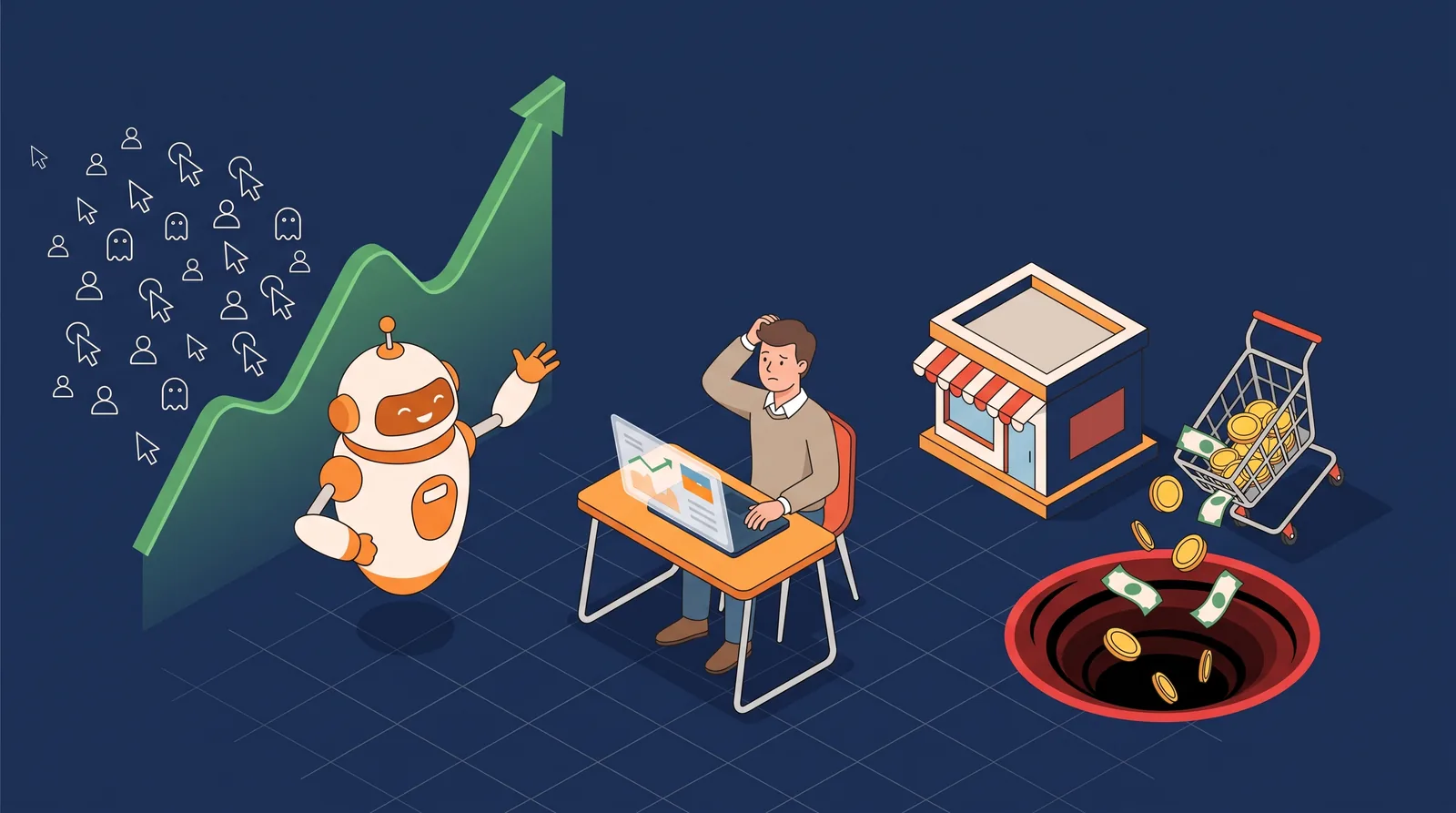
The problem is that optimizing for traffic on Meta is one of the worst choices you can make. And here’s why: the Meta algorithm gives you exactly what you ask for. You tell it “I want clicks” and it goes looking for people who click for the lowest price—not people who will buy from you. And these “cheap clickers” exist: they click on anything, land on the site, and bounce within a second. Your traffic stats will look great. Your sales won’t.
An experienced pro knows this from their own battle scars—they’ve seen (probably many times) how optimizing for traffic drives thousands of zeros into the stats and zero dollars into the register. That’s why they only optimize for traffic in rare cases; otherwise, they reach for optimization for conversion or purchases, where Meta looks for people who actually buy.
AI doesn’t have this scar. It takes your prompt, finds “campaign objective: traffic” in the documentation, and deploys it without a second thought. It won’t raise an eyebrow or say, “Wait, this is just going to drive junk traffic.” Why? Because it doesn’t know—it’s exactly the kind of real-world account experience that isn’t in any dataset. And if you don’t know that you shouldn’t optimize for traffic, you’ll launch it thinking you’ve got an “AI-recommended campaign.”
4. AI doesn’t question your prompt (and that’s what costs you the most)
And now for the trickiest part, because it goes a level deeper. Let’s go back to that brief: “I want more visits.”
Ask yourself the question every good specialist asks, but AI doesn’t: why do you actually want more visits? Almost certainly because you want more orders from those visits. So you don’t actually care about visits at all — you care about conversions. Traffic is just a means to an end that you’ve mistaken for the goal.
And here is the heart of the risk: AI doesn’t question your brief. You say “I want visits” and it will faithfully and diligently optimize for visits — because it takes your words as fact, as a task to be completed. It won’t ask “but why? Isn’t your real goal sales?”. It won’t explore the motive behind your wish. It just grants the wish.
A good specialist does the exact opposite, and it’s the first thing they do: they challenge the brief and translate it into the real goal. They hear “I want visits” and mentally translate it to “you want sales, visits are just your assumption of how to get there” — and they build the campaign for sales, not visits.
AI gives you what you ask for. A specialist gives you what you need. The difference between the two is the depth of your wallet.
As long as AI treats your wishes as orders that can’t be questioned, you’re throwing money down a black hole — and even faster because of that false sense of security (“I’m using AI, so it’s solid”). In reality, the most valuable work happens before you even launch your first campaign: by asking the right question. (I’ve already broken down how to figure out what’s actually making you money without getting distracted by vanity metrics in my article on campaign evaluation.)
5. Where AI will actually help you as an e-shop owner
I don’t want this to sound like “don’t touch it, just hire an agency.” I don’t think that — and I promised you a straight answer. As an e-shop owner, AI can genuinely help you; you just need to know where to draw the line.
Where AI adds value even without years of experience:
- It gets you up to speed — explaining terminology, formats, and how things work. It’s a great teacher you don’t have to feel embarrassed asking anything.
- It generates copy variations and ideas — ads, headlines, and descriptions. You then review and choose (the final call is still on you).
- It helps with measurement and reporting — sifting through data, spotting anomalies, and preparing overviews. A second pair of eyes that never forgets.
- It speeds up the routine — setting up structures for you to check, bulk edits, and data exports.
Where experience matters, not the tool:
- Strategy and priorities (what to do first, where to allocate the budget).
- Choosing campaign goals and optimization (see that trap with visits).
- Bidding, budget allocation, and deciding “when to step in and when to let it run.”
- Questioning the brief and translating wishes into actual business goals.
There’s a simple rule: the closer you are to the money, the more expert judgment matters, and the less a confident recommendation from a chat will help you. AI is a multiplier — it takes your level and amplifies it. If you have experience, it scales it up. If you don’t, it amplifies your mistakes and delivers them with false confidence.
So yes — go for it if you enjoy it, just do so with humility and the awareness that for the first few months, your “tuition” will cost you some burned budget. Or hire someone who knows PPC and uses AI as a multiplier, not a crutch — and the saved budget will earn it back for you.
Conclusion
Can an e-shop owner manage PPC through AI? Yes. But AI gives you capabilities, not judgment — and in PPC, money decisions are made by judgment.
Three things to take away, even if you forget everything else:
- Free AI isn’t enough. Without a connection to the advertising system (MCP/CLI) and without the skill, AI is an advisor, not a manager — and the structure it spits out makes no sense at all.
- AI knows what can be done, but not what the priority should be. You can’t glean strategy, format performance, targeting, and optimization from documentation — and AI is built only on documentation.
- AI doesn’t question your prompt. You say “I want visits” and you get visits — even if you actually wanted sales. A poorly phrased question = a burned budget, and it happens even faster with a false sense of security.
None of this means “don’t do it.” It means “go into it with your eyes wide open.” The strongest today isn’t AI or a human, but a human who knows how to use AI — and can tell when it’s giving good advice and when it’s leading them into a black hole.
Want PPC with AI, but with the certainty that it’s actually making money?
Whether you want to do it yourself and just need a steer on the integration and structure, or you want the whole thing to just run while you focus on your e-shop — I’ll be straight with you about where AI saves you money and where, without experience, it would just burn through your budget.
FAQ
- Is the free version of ChatGPT enough for PPC management? No. A free AI in your browser will give you general advice, but it won’t touch your ad account. For AI to actually build and manage campaigns, it needs a system connection (MCP connector or CLI) and the skill to build campaigns correctly. Without that, it’s a consultant, not a manager.
- What is an MCP connector and why do I need it? It’s a bridge that lets the AI talk directly to the advertising system (Google Ads, Sklik, Meta) and actually do something in it—not just talk about it. Without it, you’d have to click through everything manually yourself, and that’s exactly where expensive mistakes happen.
- Why is optimizing for visits a problem? Because the algorithm (especially on Meta) does exactly what you ask—it finds people who click for the lowest price, not those who buy. Visits go up, sales don’t. You almost always want to optimize for conversions or purchases, not visits.
- Can I trust what the AI recommends? As inspiration, yes; as a command, no. AI will confidently serve you recommendations that will tank your budget—and it won’t tell you “I don’t know this.” Without experience, you won’t reliably tell which recommendation is good. Watch the economics (profit, not vanity metrics like visits or “conversions” that might be junk).
- Will AI replace the PPC specialist? It will replace those who don’t know how to use it. On the contrary, an experienced specialist who integrates AI is faster and cheaper than before.
- Can I at least do some things myself to save money? Sure—getting your bearings, copy for review, tracking, reports, preparation that you then check. The further you are from strategy and money, the more AI helps. The closer you get to bidding, optimization, and budget allocation, the more experience matters.